
Types of ETFs
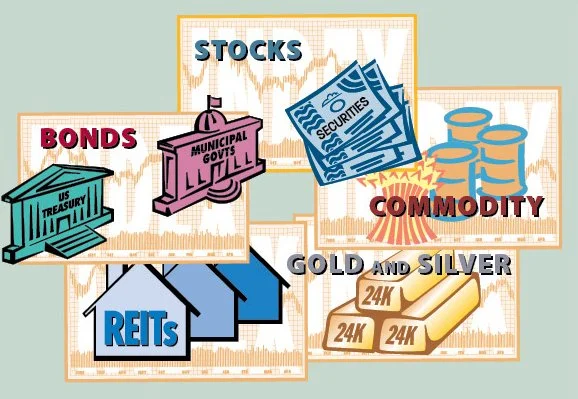
Whatever your investment objective, chances are there’s an ETF for you.
ETF sponsors, eager to meet investor demand for more ways to diversify their portfolios, continue to expand the universe of funds to encompass nearly all asset classes and investment strategies. Remember though that all ETFs, whatever their underlying investments, are themselves equity assets. You own shares in an ETF, even when the assets the ETF holds are bonds or gold bars.
EQUITY FUNDS
Most ETFs are equity funds. They hold a basket of stocks tracked by a domestic or international index if they’re index-based or chosen by a fund manager if they’re actively managed.
An index may be broad based or more narrowly focused on a sector, such as energy or communications, or on a style of investing, such as growth or value. It may be a market capitalization index which gives the most weight to the components with the most shares at the highest prices. Or it may be an index whose components are equally weighted.
Active managers select their underlying investments to achieve a particular objective, which among other things may include beating the benchmark index for the category of investments it makes. For example, a large-cap index fund might seek to replicate the performance of the S&P 500 while an actively managed fund of large-cap stocks seeks to outperform that index.
In fact, the range of ways in which equity markets can be divided and subdivided provide sponsors with seemingly endless possibilities for creating new stock ETFs. What’s more, stocks—probably the best-understood asset class, and one with a long-term track record of providing positive returns in a majority of years—are often the go-to choice for individual investors.
FIXED INCOME ETFs
Like their equity counterparts, fixed-income ETFs may be either passively or actively managed. Based on their objective, they may invest in investment-grade corporate bonds, US Treasury securities, agency bonds, mortgage- and other asset-backed securities, preferred stock, and municipal bonds among other products.
One appeal of these ETFs is the greater level of diversification you can achieve for less than it would cost to buy individual bonds. In addition, they’re easy to buy and sell, have low expense ratios, and are typically tax efficient.
Commissions, when they apply, are transparent. But fixed-income ETFs don’t pay a set rate of return or promise return of principal, two of the primary attractions individual bonds have for buy-and-hold investors.
Bond ETFs pay dividends monthly, which is more frequent than the quarterly or semi-annual interest payments from individual bonds. But since the source of this income is interest, it is taxable at the same rate as your ordinary income rather than the lower rate you pay on qualified dividends in an equity ETF.
REIT ETFs
To participate in the real-estate market, you can buy shares in ETFs that track the performance of real estate investment trusts (REITs). Those are companies that invest in commercial and residential real estate or in some cases mortgages on those properties. Most are passively managed.
The appeal of a REIT ETF is diversification without the complexity of having to research individual REITs. There’s also the expectation of more income than other ETFs provide, plus the opportunity to add an investment that can be negatively correlated to the rest of your portfolio.
There are risks with REIT ETFs, though. The underlying real estate market can be volatile. If buildings are not full or tenants default, income drops. Poor management decisions, such as too much debt, can undercut profits. In addition, income is taxed as ordinary income plus 3.8%.
COMMODITY ETFs
Commodity ETFs provide access to commodities markets, some by investing in a physical commodity while others track a commodity index or a basket of commodities, such as agricultural or energy products.
Most commodity ETFs, except those that invest in precious metals, don’t take physical possession of the commodity they track. Rather they use futures contracts to mirror the performance of the individual product or commodity index. This means the market value of the ETF reflects the changing value of the underlying contracts, not the market price of the commodity or index.
Investors are attracted to these ETFs for the risk protection they can provide because their returns are not correlated with the returns of stocks and bonds. But there are downsides, including potential credit risk and a complex tax structure. In addition, commodity ETFs are typically as volatile as the underlying market. This means they require constant monitoring and timely decision making.
GOLD AND SILVER ETFS
Investors see precious metals, gold in particular, as a hedge against market uncertainty. Before gold ETFs were introduced, the metal was generally available only in bullion, which is expensive to store and insure and difficult to liquidate. The alternative, gold mining stocks, largely reflect the performance of the mining companies and don’t always mirror the price movements of the metal itself.
In contrast, each share of a gold ETF represents one-tenth of an ounce of gold back by securely held bullion. The funds, which aren’t index based, track the price of gold in the spot market closely.
One risk with gold ETFs is that gold prices can be volatile, so an ETF could gain or lose significant value quickly. In addition, because they hold bullion, the IRS considers these ETFs collectibles rather than securities despite the way they trade. That means when you sell a gold ETF any gain is taxed at a maximum rate of 28% and not the lower capital gains tax rate.
Exotic ETFs
There are a number of highly specialized ETFs. An inverse ETF, for example, moves in the opposite direction from the index it tracks. That means the ETF goes up when the index goes down and down when the index goes up. A leveraged ETF aims to provide a return that’s twice (2x) or three times (3x) the return of its index. Both use derivative products, have higher than average expense ratios, and reset their returns on a day-by-day basis. Holding shares in either of these ETFs for more than a day or maybe two is almost certain to result in a loss.
COVERING THE TERRAIN
An exchange traded vehicle (ETV) is a publicly traded grantor trust that invests in commodities or currencies or replicates a commodity benchmark.

VIRGINIA B. MORRIS is the Editorial Director of Lightbulb Press. A noted expert on financial literacy, Virginia serves as a sought-after consultant on investor education. She has written more than forty books on financial subjects, as well as articles, white papers, financial literacy websites. She is responsible for Lightbulb’s accessible approach to explaining investing and personal finance.
Virginia holds a PhD and an MA from Columbia University.